The use of ROVs (Remotely Operated Vehicles) for the cleaning and inspection of industrial tanks allows operations in submerged environments without draining the structure, reducing plant downtime and risks for operators. This technology is particularly advantageous for large tanks, underground reservoirs, and structures that are difficult to access with traditional methods.
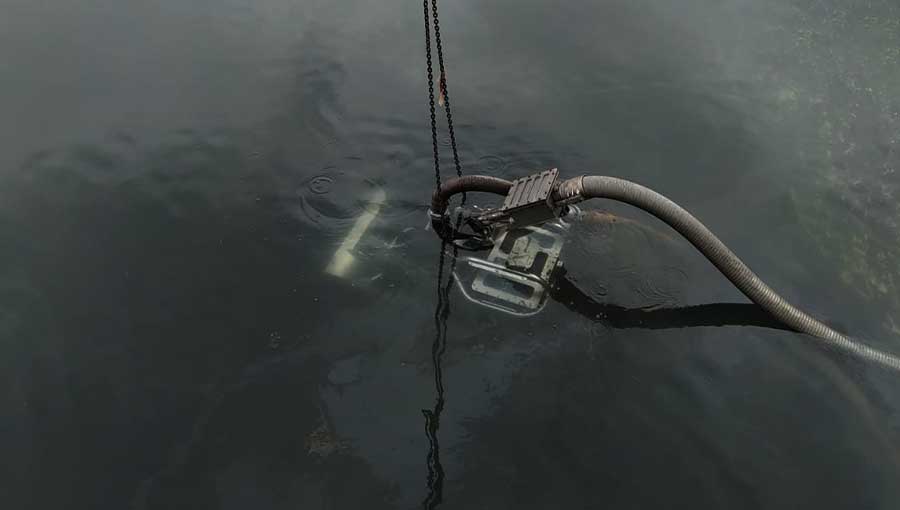
An ROV (Remotely Operated Vehicle) is a remotely controlled underwater vehicle, connected to the surface via an umbilical cable that transmits electrical power, control signals, and real-time video data. The operator manages the vehicle from a surface command station, piloting it through the submerged environment and using high-definition cameras, lighting systems, and operational tools mounted on the vehicle.
ROVs used for industrial applications are equipped with manipulator arms, high-pressure nozzles for cleaning, suction systems for sediment removal, and sensors for environmental monitoring. The combination of visual inspection capability and mechanical intervention allows both the structural condition assessment and cleaning and maintenance operations to be carried out in a single operation.
The use of an ROV is not always necessary: its suitability depends on the characteristics of the tank, the nature of the contents, and the plant's operating conditions. However, there are situations where the ROV is the most efficient and safe choice.
The use of ROV is particularly recommended when:
Under these conditions, the ROV enables effective operations while eliminating or significantly reducing the risks associated with direct human intervention in submerged or confined environments.
Advantages of ROV cleaning compared to traditional methods
Compared to traditional interventions that require complete tank draining and direct operator access, ROV cleaning offers significant advantages in several areas.
The comparison between the two approaches highlights:
| Aspect | Traditional method | ROV cleaning |
| Tank draining | Required in most cases | Not required or partial |
| Plant downtime | Extended for draining and restoration | Reduced to operational minimum |
| Operator safety | Exposure to confined spaces and substances | Operator on surface, no exposure |
| Documentation | Limited to photos and manual notes | Real-time HD video and recordings |
| Overall costs | High for draining and content management | Lower when draining is avoided |
| Execution times | Variable, often extended | Reduced by eliminating preparatory phases |
The most significant advantage of the ROV lies in the ability to combine inspection and cleaning in a single underwater operation, eliminating the need to drain the tank and drastically reducing intervention times and associated costs.
ROVs are employed in a wide range of industrial and civil applications, wherever there is a need to operate in submerged environments in a controlled and safe manner.
The most common applications include:
In each of these applications, the ROV allows otherwise inaccessible areas to be reached, the condition of the structure to be documented in detail, and targeted cleaning operations to be carried out without compromising personnel safety.
Every ROV cleaning intervention follows a structured operational protocol that ensures effectiveness, safety, and traceability of operations.
The main phases of the intervention include:
The entire intervention is monitored in real time by the operator on the surface, who can adapt the cleaning strategy based on what the ROV cameras detect during operations. The final report, accompanied by video and images, provides the client with complete documentation of the tank's condition before and after the intervention.
Despite the significant advantages, the use of ROVs has some limitations that must be assessed during the intervention planning phase. ROVs operate most effectively in tanks with low-turbidity liquids, where visibility allows the operator to guide the vehicle with precision. In the presence of very turbid or dense liquids, visibility may be reduced and operations require more time or the use of supplementary sonar sensors.
Furthermore, access to the tank must allow the immersion and recovery of the vehicle: openings that are too narrow or particular structural configurations may require specific adaptations. The nature of the sediments to be removed affects the choice of tools: very compact sediments or large solid materials may require the integration of the ROV with other support equipment.
ROV tank cleaning is a specialised service that requires qualified operators, professional underwater vehicles, and established experience in managing interventions in submerged environments. The quality of the intervention depends on the ability to select the vehicle and tools most suitable for the specific conditions of the tank.
Franchini Servizi Ecologici carries out cleaning and inspection of industrial tanks with ROV technology, employing professional underwater vehicles equipped with HD cameras, high-pressure cleaning systems, and suction tools. Every intervention is documented with detailed video reports and conducted in full compliance with current safety and environmental regulations.
The cost of an ROV intervention depends on the tank dimensions, depth, nature of the sediments, and duration of operations. In many cases, however, the overall cost is lower than the traditional approach because the costs associated with tank draining, content management and disposal, subsequent refilling, and extended plant downtime are eliminated. The savings are particularly significant for large tanks or those containing liquids that would require specific treatment before disposal. In any case, a preliminary assessment allows the costs of both approaches to be compared and the most cost-effective solution for the specific conditions of the tank and plant to be identified.
The ROV can operate in most industrial tanks, provided that some minimum access and visibility requirements are met. The tank must have an opening sufficient for the immersion and recovery of the vehicle, and the contained liquid must allow adequate visibility for camera-guided operations. In the presence of very turbid liquids, ROVs can be equipped with sonar sensors to supplement visual navigation. Tanks with particularly complex geometries, significant internal obstacles, or very high-density contents may require a specific preliminary assessment to verify the feasibility of the intervention and select the most suitable vehicle.
Industrial ROVs can remove a wide range of sediments: sludge, silt, sand, scale, organic deposits, and particulate materials that accumulate on the bottom and walls of tanks. Removal is carried out using high-pressure nozzles that detach sediments from surfaces and suction systems that convey them outside for disposal. For very compact sediments or particularly resistant scale, mechanical tools mounted on the vehicle's manipulator arms can be used. Large solid materials, such as debris or bulky objects, may require the combined use of the ROV with other lifting or suction equipment. In any case, the type of sediments is assessed in the preliminary phase to select the most effective operational tools.
One of the main advantages of ROV cleaning is the ability to operate without requiring complete plant shutdown. Since the ROV works inside the tank without the need for draining, sections of the plant not directly involved can continue to operate normally. In many cases, it is sufficient to temporarily isolate the tank being serviced, diverting flows to alternative lines or temporarily reducing throughput. Downtime is generally limited to the time strictly necessary for cleaning operations, which can range from a few hours to one or two days depending on the tank dimensions and the amount of sediment to be removed. This operational flexibility is particularly valued in continuous-cycle plants where each day of downtime involves significant costs.
At the end of every ROV intervention, a complete technical report is produced that includes full video recording of operations, with high-definition images of the tank's condition before and after cleaning. The report documents the conditions found, the type and distribution of removed sediments, any structural anomalies identified during inspection, and the cleaning operations carried out. This documentation has significant value not only for verifying the quality of the intervention but also for planning future maintenance and for compliance with regulatory requirements. Video recordings can be used as a reference to compare the condition of the structure over time and to support decisions regarding any subsequent maintenance or repair interventions.